
Early life and education
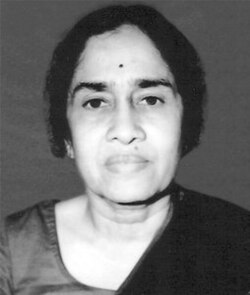
Kamala Sohonie, born Kamala Bhagvat, was born in Indore on 18 June 1911 into a family of chemists. She graduated from the University of Bombay in 1933 with a first-class BSc, studying Chemistry as her principal subject and Physics as a subsidiary subject.
She then sought admission to the Indian Institute of Science in Bengaluru. Despite initial resistance based on her gender, her persistence secured her a place in biochemistry. Working with M. Sreenivasaya, she studied proteins in milk, pulses and legumes and completed her MSc with distinction in 1936.
Cambridge research
Sohonie entered Newnham College, Cambridge, in 1937 and worked first with Derek Richter at the Frederick Gowland Hopkins laboratory and later with plant physiologist Robin Hill. Her research examined respiration in plant tissue.
Working with potatoes, she identified cytochrome c in plant cells, an enzyme central to cellular energy transfer. She completed her concise doctoral thesis in 14 months and received her PhD from Cambridge in 1939.
Scientific career in India
Returning to India in 1939, Sohonie became Professor and Head of Biochemistry at Lady Hardinge Medical College in New Delhi. She later worked as Assistant Director at the Nutrition Research Laboratory in Coonoor, where she studied vitamins and nutrition.
After moving to Bombay in 1947, she joined the Royal Institute of Science as Professor in the Department of Biochemistry. Her work with students focused on the nutritional value of legumes and staple foods consumed by economically disadvantaged communities. She later became Director of the Institute.
Neera and public nutrition
At the suggestion of President Rajendra Prasad, Sohonie investigated Neera, the sap collected from toddy palm inflorescences. Her research found useful quantities of vitamin A, vitamin C and iron, and showed that these nutrients could remain present when Neera was concentrated into palm jaggery and molasses.
Subsequent dietary studies found that Neera could serve as an inexpensive supplement for malnourished children and pregnant women in tribal communities. She received the Rashtrapati Award for this work.
Leadership and legacy
Sohonie's career challenged barriers facing women in Indian science while also demonstrating the social value of biochemical research. Her leadership of the Royal Institute of Science placed a pioneering woman scientist at the head of one of India's historic scientific institutions.
She was active in the Consumer Guidance Society of India, served as its President in 1982-83 and wrote about consumer safety. She died in New Delhi on 28 June 1998. In 2023, a Google Doodle marked her 112th birth anniversary and renewed public attention to her scientific legacy.