

Early life and the Royal Institute
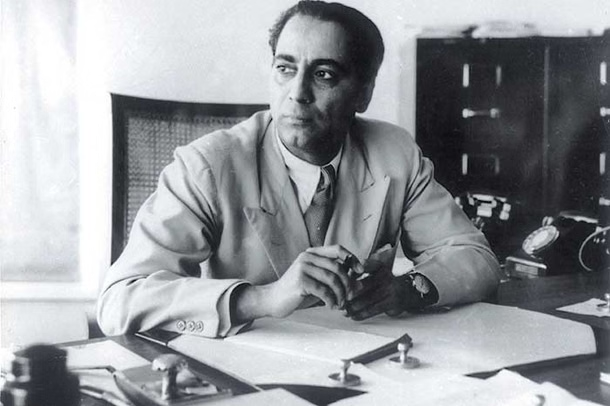
Homi Jehangir Bhabha was born in Bombay on 30 October 1909 and studied at the Cathedral and John Connon School before enrolling at Elphinstone College. In 1927 he attended the Royal Institute of Science, the former name of The Institute of Science, Mumbai.
At the Royal Institute he heard a public lecture by the American physicist Arthur Compton. Bhabha later recalled that this was where he first encountered cosmic rays, a subject that became central to his early research.
Cambridge and theoretical physics
Bhabha entered Gonville and Caius College, Cambridge, in 1928. He completed the Mechanical Sciences Tripos with first-class honours in 1930 and the Mathematics Tripos with first-class honours in 1932, before completing his doctorate under Ralph H. Fowler in 1934.
His work addressed positrons, electron-positron interactions and high-energy cosmic radiation. The probability of electron-positron scattering that he calculated became known as Bhabha scattering. With Walter Heitler, he developed an influential account of the particle showers produced when cosmic rays enter the atmosphere.
Building India's research institutions
When the Second World War prevented his return to Europe, Bhabha joined the Indian Institute of Science in Bengaluru as a Reader in Physics. Convinced that India needed a first-rate centre for fundamental research, he prepared a proposal that received support from the Sir Dorabji Tata Trust.
The Tata Institute of Fundamental Research was founded in 1945 with Bhabha as its founding director. In 1948 he became the first Chair of the Atomic Energy Commission and subsequently served as the first Secretary of the Department of Atomic Energy. He also founded the Atomic Energy Establishment at Trombay and developed a long-term programme for nuclear science and energy suited to India's resources.
Science, public life and the arts
Bhabha represented India internationally and presided over the first United Nations Conference on the Peaceful Uses of Atomic Energy in Geneva in 1955. He served as President of the International Union of Pure and Applied Physics from 1960 to 1963.
His interests extended well beyond physics. He painted, designed, listened deeply to classical music, supported modern Indian artists and treated architecture and landscape as essential parts of scientific institutions. The art collection and visual character of TIFR reflect that integrated vision.
Legacy
Bhabha died on 24 January 1966 when Air India Flight 101 crashed near Mont Blanc. After his death, the Atomic Energy Establishment at Trombay was renamed the Bhabha Atomic Research Centre.
His legacy lies both in theoretical physics and in the national institutions he created. TIFR, BARC, the Atomic Energy Commission and later scientific programmes in electronics, radio astronomy and space research all bear the imprint of his conviction that advanced research institutions were central to India's development.